

For four years, eastern Democratic Republic of the Congo (DRC) has been the scene of a war in which weapons represent only one dimension of the conflict. The other battlefield—less visible, more sophisticated, and at times more decisive—lies in the diplomatic, media, and narrative arenas. In this domain, the Rwandan regime has waged a campaign of remarkable effectiveness.
One point must be stated clearly from the outset: the foundation of Rwanda’s narrative is largely fictitious, often factually false, and in many instances entirely deceptive. The threats invoked, the justifications advanced, and the ideological premises promoted do not withstand even basic empirical scrutiny.
Yet in the brutal grammar of realpolitik—which continues to structure contemporary geopolitics and international relations—truth carries less weight than a narrative’s ability to impose itself. What ultimately matters is a story’s strategic effectiveness: its capacity to shape perceptions, influence decision-making, and lock in alliances.
Paul Kagame’s regime has understood this better than anyone in the region. Since the resurgence of the M23 rebellion, Kigali has not merely conducted a military operation; it has pursued a sophisticated campaign of narrative engineering—carefully designed to influence mediators, blur responsibility, invert roles, and recast the aggressor as a supposed victim facing an existential threat.
To grasp the current dynamics, one must examine how Rwanda has constructed, relentlessly repeated, and successfully imposed a series of mutually reinforcing narratives that have gradually penetrated even the most sensitive diplomatic processes. The war in Congo is no longer solely territorial. It has become a war of narratives—and in that war, Kigali has gained a decisive head start, structured around at least five key axes.
I. Strategic Denial: Dissociating the M23 from Rwanda Despite Four Years of Overwhelming Evidence
The first pillar of Rwanda’s strategy rests on a consistently repeated falsehood: that Rwanda does not support the M23 and has no troops on Congolese soil. This claim is maintained with unwavering discipline, despite an accumulation of evidence that leaves no room for ambiguity.
For four consecutive years, the UN Group of Experts has continuously documented the direct involvement of the Rwanda Defence Forces (RDF) in the DRC: the provision of weapons, training and command of M23 fighters, deployment of Rwandan troops on Congolese territory, logistical support, and the use of drones and surface-to-air missiles.
A major investigation by NBC News, supported by geolocated videos, satellite imagery, and corroborating testimonies, describes an “extensive” Rwandan military presence inside the DRC. Intelligence services from the United States, the United Kingdom, France—and even China—possess converging evidence robust enough to allow their diplomatic services to state unequivocally that Rwanda supports the M23 and deploys troops on Congolese territory.
This reality has been formally acknowledged at the highest multilateral level. UN Security Council Resolution 2767, adopted unanimously, explicitly identifies Rwanda—without any conditional language—as supporting the M23 and operating militarily in the DRC.
And yet, Kigali continues to deny it. Relentlessly.
This denial is not a mistake; it is a deliberate strategic choice. It preserves enough ambiguity to disrupt mediation efforts, divide African peers, prevent explicit Western condemnation, and maintain military flexibility. By repeating the falsehood until it becomes a parameter of the debate—even when widely recognized as such—Rwanda neutralizes the core issue: its direct involvement.
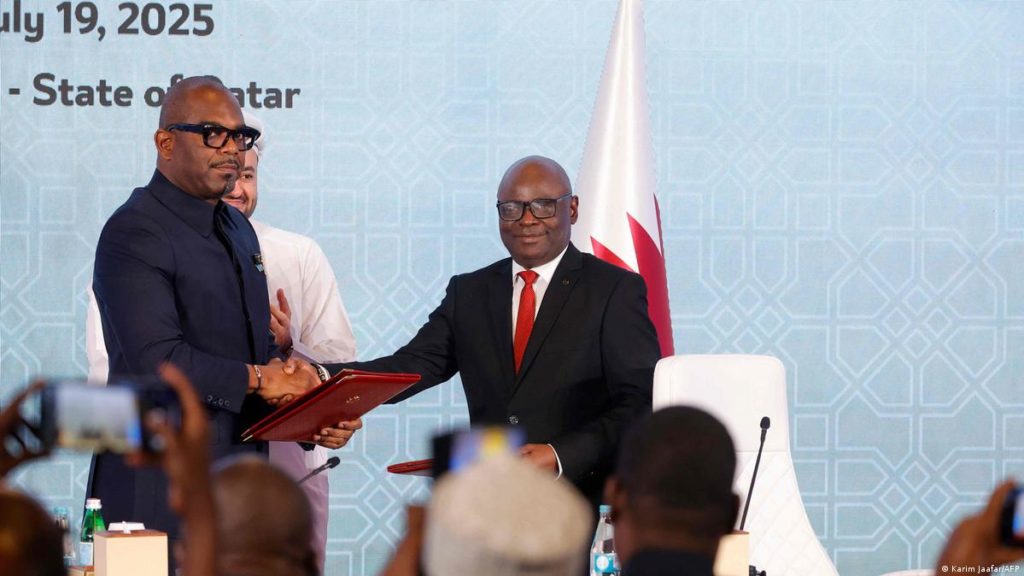
This denial also enabled Kigali’s first major diplomatic victory: the artificial fragmentation of the conflict into two separate tracks—one addressing Rwanda–DRC relations (Washington), the other framing the war as an “internal Congolese conflict” between Kinshasa and the M23 (Doha). When, following military defeats in Goma and Bukavu, Kinshasa accepted direct negotiations with the M23 without Rwanda’s participation, Kigali obtained precisely what it sought: implicit recognition of the separation between the M23 and the Rwandan state. This marked the first major narrative shift of the crisis.
This “Congolization” of the conflict was further reinforced by the artificial creation of the AFC, which emerged well after hostilities resumed and was quickly folded into the label AFC-M23. Marketed as a broad Congolese political platform, fronted by figures from western, Lingala-speaking regions, the AFC functions in reality as a camouflage device.
The true core of the movement consists primarily of Congolese Kinyarwanda-speaking fighters—alongside RDF troops—and, crucially, Rwandan officers who exercise effective command. They define strategic direction, control command chains, and serve as direct conduits for the logistical, financial, military, and political support provided by Kigali.
In short, Rwanda’s military power would have been insufficient without its narrative power.
II. Manufacturing the Victim: The FDLR Threat as the Cornerstone of Rwandan Diplomacy
The second narrative pillar rests on a simple claim: Rwanda is allegedly engaged in an existential struggle against the FDLR, portrayed for three decades as the unbroken continuation of the perpetrators of the 1994 genocide.
This narrative has become the central axis of Rwanda’s diplomacy. It appears in every statement from the Ministry of Foreign Affairs, every presidential speech, every diplomatic intervention. Everything converges toward a single assertion: the existence of a permanent genocidal threat that justifies all actions, including military incursions into the DRC.
Yet this narrative collapses under scrutiny.
The FDLR does not represent a strategic threat to Rwanda. It has carried out no major cross-border attacks for over twenty years. The majority of its members have no connection to the forces involved in 1994; they are young people born and raised in exile in the DRC, many of whom have never set foot in Rwanda. Their roots are as social as they are political, embedded in refugee communities that Kigali continues to refuse as legitimate political interlocutors.
The International Criminal Tribunal for Rwanda (ICTR) has never classified the FDLR as a genocidal organization. Rwanda itself has integrated dozens of former FDLR and ex-FAR members into its army and state institutions.
The official Rwandan discourse is therefore a political construction, not a security reality.
And yet, this construction permeated the Washington Agreements, to the point that the entire framework of the text places the “neutralization of the FDLR” at the center of the proposed solution.
III. The “Saving” Narrative: Preventing the Alleged “Genocide of Congo’s Tutsi”
Since 2022, Kigali and its networks have patiently built a new narrative: that Congolese Tutsi, Banyamulenge, and Rwandophone communities are on the brink of genocide in the DRC. This discourse has become omnipresent in official communication, amplified by coordinated disinformation campaigns and troll networks.
Several converging actions reveal the methodical nature of this construction. Kigali has flooded social media with unverifiable videos presented as evidence of an “imminent genocide.” Fake accounts posing as Congolese have disseminated hateful content; new geolocation features on X have allowed several of these accounts to be identified as operating from Rwanda. These materials are then recycled as purported “proof.”
Under coordinated diplomatic pressure, UN bodies have multiplied statements warning of “hate speech” in the DRC. Kigali has also accused Burundi of committing genocide against Banyamulenge in South Kivu—an accusation that served to justify military operations toward Uvira and Minembwe.
This discourse did not exist when relations between Presidents Tshisekedi and Kagame were warm. It was absent in 2019, 2020, and 2021. The narrative of an impending genocide did not arise from objective conditions; it arose from strategic necessity.
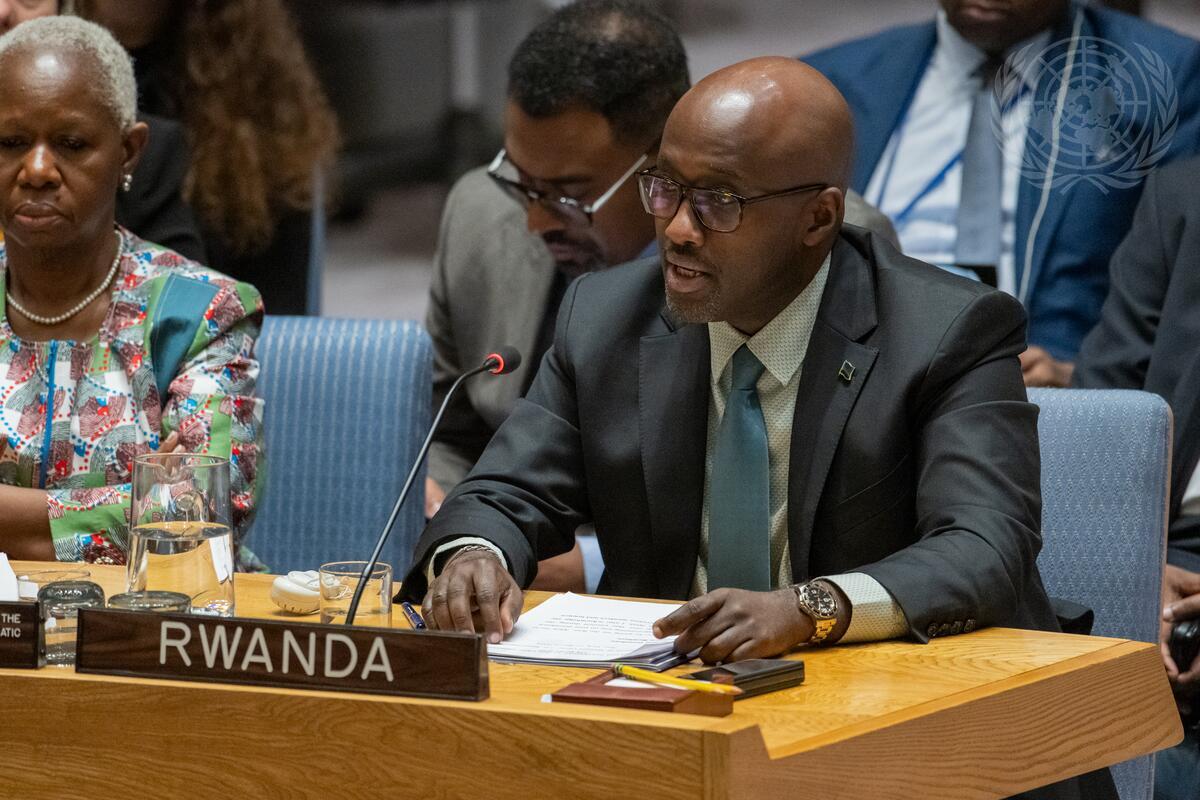
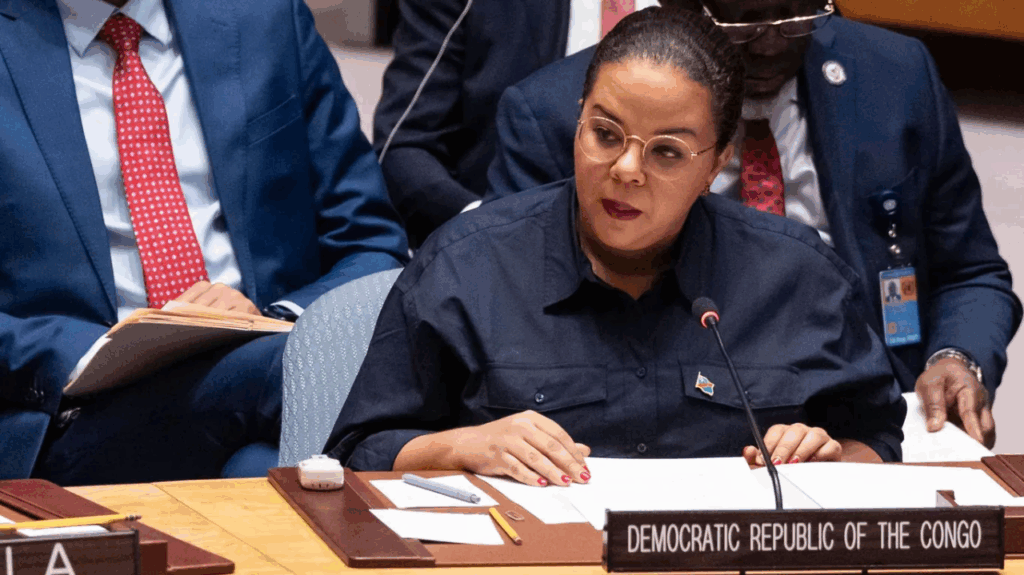
A striking illustration occurred during the UN Security Council meeting of 13 December 2025, following the fall of Uvira. While nearly all Council members explicitly accused Rwanda of supporting the M23 and violating the ceasefire, Rwanda’s ambassador, Martin Ngoga, devoted most of his statement to his personal history as a survivor of the 1994 genocide, the international community’s failure at the time, and allegations of a silent genocide being carried out against the Banyamulenge by the DRC and Burundi.
To observers familiar with the region, the intervention seemed disconnected from the issue at hand. In reality, it was meticulously calculated. No regime has mastered the instrumentalization of the 1994 genocide more effectively than Kigali, using it to deflect criticism, shift debates, and legitimize an aggressive regional policy.
By embedding this narrative in diplomatic consciousness, Kigali has created conditions under which military intervention can appear humanitarian. If Congolese Tutsi are “on the brink of genocide,” then military action becomes a moral imperative.
This narrative directly transposes the legitimacy acquired by the RPF in 1994 into the Congolese context, replicating the founding myth that consolidated the regime’s power.
IV. How Kigali Imposed Its Narrative as the Architecture of the Washington Agreement
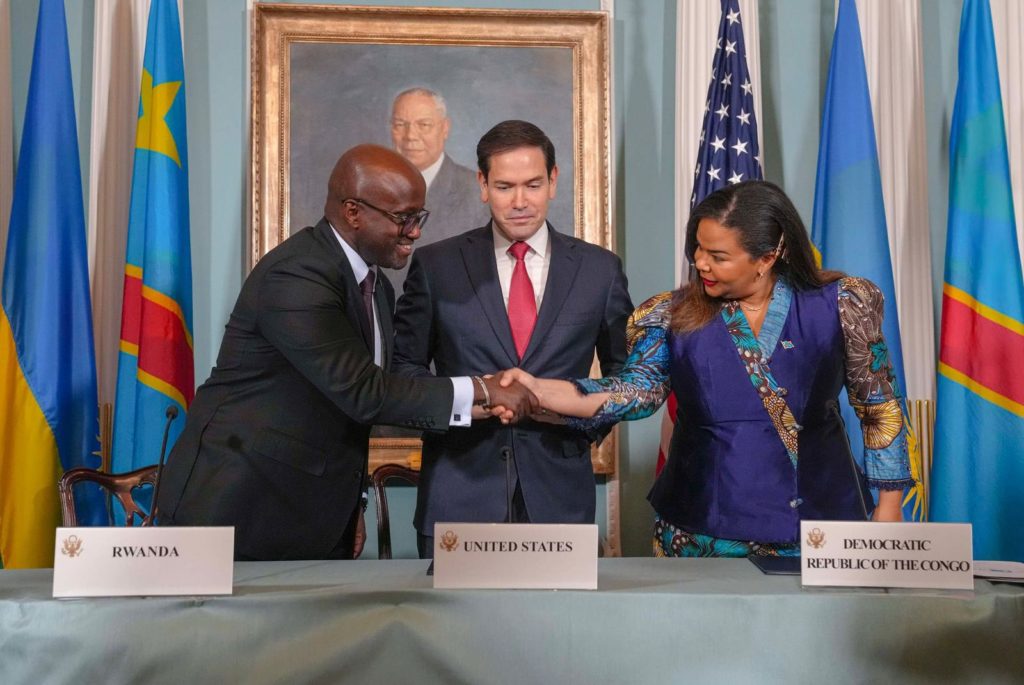
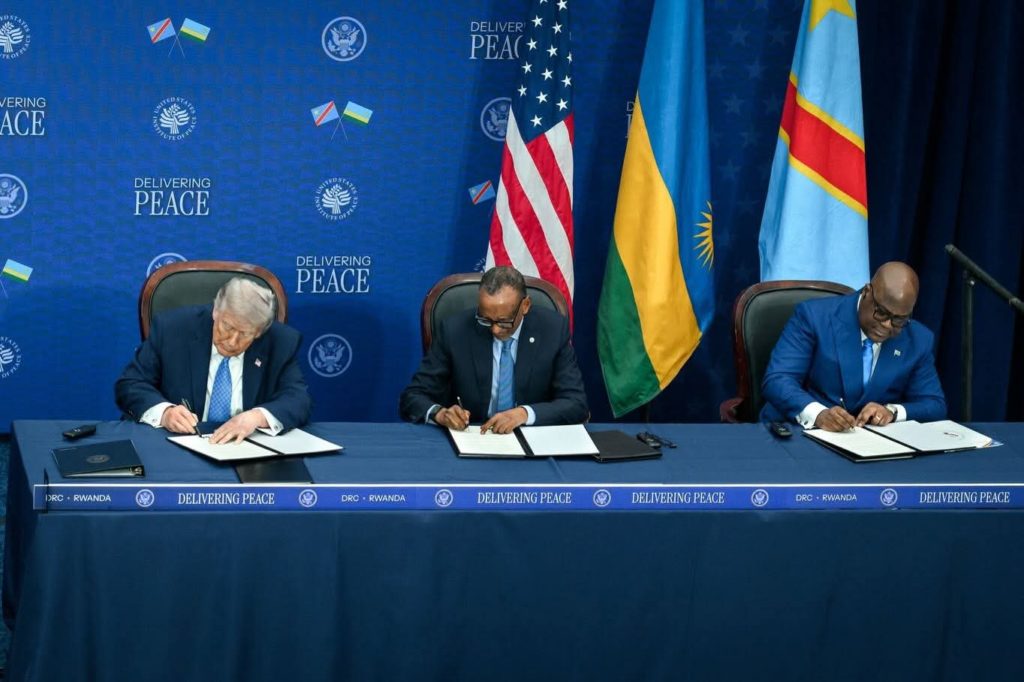
One of the most decisive—and least acknowledged—aspects of the current crisis is that the Washington Agreement is not the result of a balanced compromise, nor of a neutral security assessment. At its core, it is built on Rwanda’s narrative. The structure of the text, its priorities, its formulations, and even its vocabulary reflect a conceptual framework Kigali has methodically imposed since the war began: everything revolves around the “neutralization of the FDLR” and the “lifting of Rwanda’s defensive measures.”
Presented as technical elements, these pillars are in fact political instruments. They divert international attention from Rwanda’s military role in the M23 offensive and recenter the debate on a threat that is exaggerated, residual, or fictitious—but narratively central.
From the first reading, one fact stands out: the neutralization of the FDLR is not one objective among others; it is the condition, logic, and raison d’être of the entire process. Kigali succeeded in imposing this centrality, forcing both the DRC and the United States to accept a strategic fiction as the foundation of an international treaty.
The consequences are profound. By making peace contingent on dismantling a politico-military group that, on paper, shares the same enemies as the Congolese army and Wazalendo militias, the agreement shifts primary responsibility onto Kinshasa while imposing an almost insoluble equation. The DRC is tasked with neutralizing, across a territory the size of Western Europe, a mobile group largely operating in zones controlled by the RDF and the M23, whose threat to Rwanda is not remotely comparable to the threat the M23 poses to the Congolese state.
Kigali knew this condition was unattainable. That is precisely why it was elevated to a prerequisite for progress. A peace built on impossibility—that is the trap.
The second narrative pillar is even more subtle. The agreement introduces, without defining them, Rwanda’s so-called “defensive measures.” The phrase is lifted verbatim from the Luanda CONOPS, a technical document never intended to become a peace treaty. The term is deliberately empty: no legal definition, no geographic limit, no criteria for activation or withdrawal. No one knows what constitutes a “defensive measure” by Rwanda in the DRC—neither the agreement, nor Kigali, nor the mediators specify it.
This ambiguity is precisely what makes the concept powerful. Without boundaries, it can cover anything: direct military presence, logistical support to the M23, occupation of strategic zones—and potentially advances toward Uvira, Katanga, or beyond. What was supposed to frame disengagement becomes a diplomatic blank check.
Kigali imposed these terms by exploiting US strategic impatience. The Trump administration, seeking rapid diplomatic wins for domestic political reasons, needed an agreement—and fast. Substance mattered less than optics. At the moment Rwanda seized Goma and Bukavu, it held military, diplomatic, and media dominance. It dictated terms. Washington accepted a peace agreement that was little more than a near-verbatim reproduction of the Luanda CONOPS—a technical document repurposed as a political treaty.
Rwanda was never satisfied to sign such an agreement at that moment. Confident in its military advantage and pursuing broader objectives of weakening Kinshasa, Kigali had no intrinsic interest in constraint. It accepted the agreement not out of compromise or peace-making intent, but because the text codified its narrative logic. By embedding its key concepts—FDLR centrality, ambiguity of “defensive measures,” dissociation of the M23—Rwanda accepted a formal constraint that, in practice, legitimizes rather than restrains its strategy.
V. The Closing of the Narrative Trap: When Reality Is Rewritten
Once enshrined in an international agreement, Kigali’s concepts ceased to be mere talking points and became binding frames of reference. They now shape how mediators analyze the conflict, interpret violations, and allocate responsibility. Rwanda no longer needs to persuade; the narrative has been institutionalized.
This is where the final inversion occurs. Kigali no longer simply denies involvement; it actively rewrites reality. A statement from Rwanda’s Ministry of Foreign Affairs on 10 December 2025 illustrates this clearly. While the M23 was advancing toward Uvira, Kalemie, and Lake Tanganyika—hundreds of kilometers from Rwanda—Kigali accused the DRC and Burundi of “bombarding villages near Rwanda’s border.” The factual gap is obvious, but the strategy lies in reframing: every offensive becomes a reaction, every ceasefire violation a response, every military advance a “humanitarian necessity.”
Rwanda’s strength now lies less in its troops than in its ability to make its narratives operational within diplomatic arenas. Through repetition, they become more credible than the facts they contradict. In contemporary geopolitics, words—more than maps—define aggressor, victim, and arbiter.
One of the most effective maneuvers remains the inversion of negotiation responsibility. While political and historical logic would suggest Kigali should address the FDLR—an organization of Rwandan origin inseparable from the unresolved refugee issue—Rwanda has imposed the opposite premise: that Kinshasa must negotiate with the M23, framed as an autonomous Congolese actor. This maneuver spares Kigali any political discussion on the FDLR while forcing the DRC to negotiate with a movement Rwanda structures, commands, and supports. Rwanda positions itself as an external arbiter of a conflict it shapes from within, while the DRC bears political responsibility for a war whose real levers lie elsewhere.
Conclusion: To Win the War on the Ground, One Must First Win the War of Words
The conflict devastating eastern Congo is not only military; it is profoundly narrative. Rwanda has not merely deployed troops, equipment, and proxies—it has deployed a carefully constructed narrative architecture, largely deceptive and at times entirely fictitious, yet internally coherent.
This discursive edifice, more than battlefield victories alone, has enabled Kigali to influence Washington, divide African partners, weaken Kinshasa’s diplomatic position, and delay international sanctions. The harsh reality is not that major powers are unaware that Rwanda is the aggressor—they know. It is that Kigali has, for now, neutralized the instruments required to sanction it: legal frameworks, burden of proof, terms of debate, and even the language of peace.
The combination of Rwanda’s narrative advantage and its military advances has constrained the DRC’s ability to mobilize firm diplomatic support, including from mediators such as the United States. As long as the dominant narrative remains Kigali’s, meaningful political shifts in favor of Kinshasa remain difficult—though recent US reactions following the Uvira offensive suggest this balance may evolve.
The DRC must draw a central lesson: without waging its own narrative battle, it will continue fighting a war whose language, framework, and conclusions have already been written by its adversary.
After four years, a sharper understanding of Rwanda’s strategy is emerging among Congolese leaders. This growing clarity is a political gain—but it remains insufficiently reflected in diplomatic instruments themselves: signed agreements, joint communiqués, mediation frameworks, official language. In international relations, what is not written does not exist.
Moreover, several realities capable of underpinning a robust Congolese counter-narrative remain absent from official discourse—notably the presence of over 200,000 Rwandan refugees in Congolese territory, mostly Hutu, currently targeted by RDF/M23 violence, forced returns, and exclusionary policies, precisely because of their identity, while being systematically denied civic, political, and security rights in Rwanda.
If Kinshasa views the M23 as a proxy rather than an autonomous actor, if it considers the FDLR not to constitute an existential threat to Rwanda, if it challenges the very premises or alleged execution of a genocide against Tutsi-associated communities in the DRC, then these positions must be explicitly and legally reflected in negotiated texts and formal declarations. Otherwise, the opposing narrative will continue to structure the reference framework of mediators and international partners.
The military balance remains difficult in the short term. But this does not justify narrative silence or tacit acceptance of biased discursive frameworks. The narrative battlefield remains the primary space where political and diplomatic advances are still possible—provided it is engaged with coherence, discipline, and persistence.
In this context, Congolese strategy cannot be reduced to repeated calls for sanctions. In an environment where the dominant narrative is shaped by Kigali, such appeals struggle to gain traction. To become effective, the terrain itself must first be transformed: responsibilities clarified, narrative artifices dismantled, and the political and legal conditions created for international partners—including mediators—to act without ambiguity.
Norman Ishimwe Sinamenye
www.jambonews.net